
|
This is my second project. As it is one of the early projects, it's still a low precision experiment with lots of ducttape but fun to keep on the website. |

|
|
|
Purpose of the experimentThe speed of light is actually used to define the meter, so considering this definition I'm actually measuring the length my laser pulse has travelled. But before the definition of the speed of light the meter was defined by a reference model of one meter long. From this length the speed of light was determined experimentally. As the experiments became more precise than the standard of the meter a new definition for the meter was made. The speed of light was constant and more fundamental than a reference model of one meter. I will be doing a similar experiment. I start with a known distance and I measure the transit time of a laser pulse. If all measurements are right, I should measure a speed of light equal to the definition, considering I use the meters as used in that definition. The challenge is measuring the short time it takes for light to travel a large distance. In a nanosecond the light will already travel 0.3 meter. To have some accuracy in measuring the speed of light within the limited distance available the whole system must have nanosecond accuracy. The required bandwidth will be in the hundreds of megahertz. |
|
|
|
|
first tryAs you can see below the setup I then had in my room was already quite nice. A 400MHz HP 54502A, a Keithley 6.5 digit DMM and a BNC 500 pulse generator. At that time I preferred the metrahit multimeters, as you can see I had 3. They're high quality 4.5 digit DMM's, probably comparable to a good FLuke, but because those are popular and thus high in price I went for these. 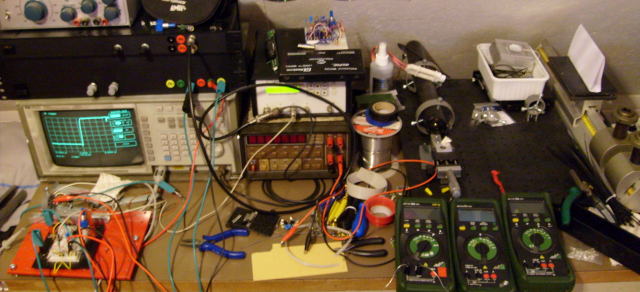
My lab when it was still smallThe actual setup is on the red DIY optical breadboard. The pulse generator driver a mosfet on a breadboard which switches the power to what's left of the laser pointer. It's a bullet style pointer of which I removed the casing and batteries. That leaves the switch (which I bypassed), the resistor and laserdiode. Varying the supply votlage will determine the power output of the laser diode. On the same breadboard is the photodiode. It has a 12v bias and the output is measured by the oscilloscope probe. Unfortunately the parasitic capacitances of this setup are relatively large, so it's no surprise the bandwidth of this system is lower than the individual components. The scope (HP 54502A) is 400MHz (100MHz single shot), the probe (Agilent N2863A) 300MHz and the photodiode (Osram SFH213) has a risetime of 5ns 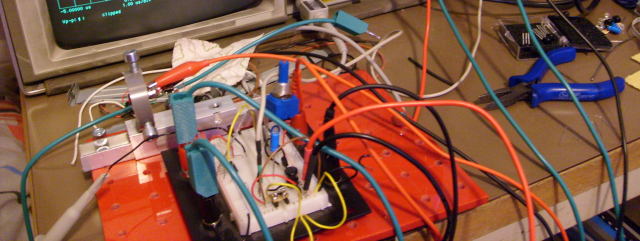
The setup usedIt's no surprise the risetime of the complete system is low if the system is build on a breadboard and all connecting wires are long. Pointing the laser straight into the photodiode gave a risetime around 500ns, which for light is 150 meter long 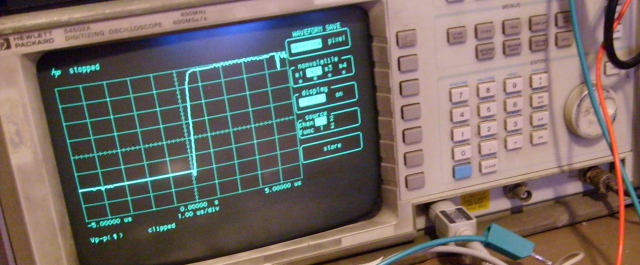
The risetime of the system |
|
|
|
|
First measurement resultThe setup now moved to the ground because I used the hallway and the room opposite to mine to create a distance for the light to travel. I got a 7.5 meter separation between the laserdiode and photodiode setup and the reflector. The roundtrip is thus 15 meters long, or 50ns. 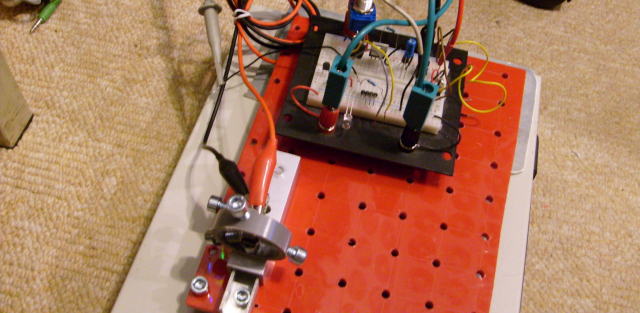
The setup at the groundAs a reflector I used a prism on an adjustable platform. Inside the prism the light reflects twice. This way a rotation along the vertical axis of the prism does not affect the alignment. I do not have a corner cube prism, this would reflect the light straight back as long as the alignment is roughly right. 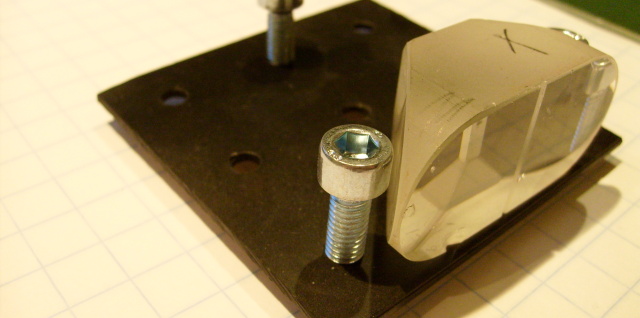
The prism to reflect the light backThe laser from the pointer has a large divergence. The light eventually coming back was much lower in intensity. Focusing the light with a lens on the photodiode helpen a bit, but the lower light intensity still caused a longer risetime. The two vertical markers indicate a 50ns delay that a 15 meter distance would cause. Because of the long risetime the marked 50ns is not a reliable mesurement. The two measurements were made after eachother and saved on the oscilloscope. By triggering the oscilloscope in the pulse generator the results can be compared. 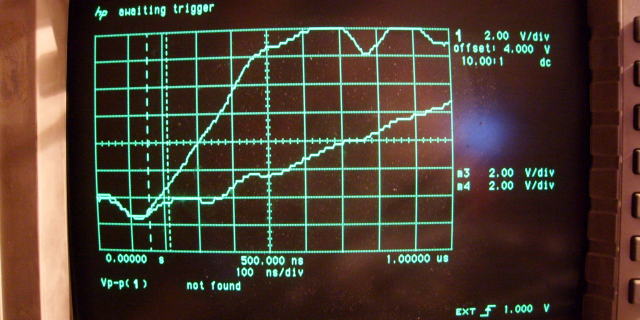
The risetime of the system |
|
|